
JEE Main 2026 Registration begins


Content Curator | Updated On - Jun 17, 2026
The JEE Main 2026 Registration is completed, and the exam will be held in 2 sessions, Session 1 from 21st to 30th January 2026, and JEE Main Session 2 will be held from 2nd April 2026 to 9th April 2026.
- The City Intimation Slip for JEE Main 2026 will be released in the first week of January 2026, which will include the city of exam and the exam date.
- The JEE Main Admit Card will be released 3-4 days before the exam, including the exam time, centre name, and address, and is compulsory for entering the exam hall.
… Read More Read Less
As around 1.5 months are left for Session 1, you should focus more on revision of NCERT Concepts, important formulas and high-weightage topics in all subjects. From now on, you should at least do 2-3 full-length mock tests per week, along with practising the previous-year papers to focus on conceptual clarity and problem-solving speed.
More than 14.5 lakh candidates are expected to appear in JEE Main 2026, which shows an increase in overall registration.
In JEE Main 2025, 13,11,544 candidates registered for the January session, from which 12,58,136 actually appeared, and in both sessions, 14,75,103 unique candidates appeared.
Check:
What is JEE Main 2026?
The JEE Main 2026, conducted by NTA, is for admission to NITs, IITs, and GFTIs and as a qualifying exam for JEE Advanced. The JEE Main Exam will be held in a CBT mode, except for the Drawing section of Paper 2A (B.Arch).
- The JEE Main Paper 1 will cover Physics, Chemistry and Mathematics, including 25 questions, 20 MCQs + 5 Numerical Value, making a total of 75 questions of 300 marks.
- In JEE Main, +4 marks will be given for each correct answer, and -1 mark will be deducted for each incorrect answer.
- The JoSAA Seats are distributed as around 18,160 seats in IITs, 24,525 seats in NITs, 9,940 seats in IIITs and 10,228 Seats in other GFTIs.
Check this video by @collegedunia to know complete detailed information about JEE Main 2026.
Check:
Big Changes in JEE Main 2026
The NTA has announced some major changes in the JEE Main 2026 to reflect a strong shift towards digital modernisation, more transparency in the exam, and inclusivity.
- Live Photo Capture: Candidates’ live photos will be taken via webcam during form filling to ensure real-time identity verification and prevent fake or edited photos.
- Aadhaar e-KYC Verification: Candidate details (name, photo, gender, DOB) will be auto-verified using Aadhaar, reducing form errors and verification time by 25–30%.
- Exam City Based on Aadhaar Address: Examcentress will be allotted as per Aadhaar address to prevent manipulation, and NTA has increased the exam centres to 323.
- Accessibility Mode for PwD Candidates: New assistive tools like magnifier, dark mode toggle, and larger fonts have been introduced to improve accessibility for 2,000–2,500 PwD candidates. The keyboard navigation has also been introduced; now you can use the UP and DOWN keys to navigate the questions without needing to scroll.
- On-Screen Calculator: For the first time, an on-screen calculator will be available during the exam to reduce calculation errors and save time, improving accuracy by 2–3%.
Also Read: How to crack JEE Main 2026?
Ques. Will JEE Main 2026 be the toughest?
Ans. Yes, JEE Main 2026 is very likely to be tougher than the previous years (2025-2022) because:
- From JEE Main 2025, section B has been removed, which means all questions are compulsory to attempt: 75 questions total (25 each in physics, chemistry, and maths, all compulsory. Negative marking applies to every question.
- In 2024, the JEE Main exam was a moderate but lengthy paper, where mathematics was the most difficult.
- In 2023-2022 the exam was moderate to difficult, with some relief due to optional numericals.
Ques. Is 75% compulsory for JEE Main?
Ans. No, 75% is not compulsory to appear for the JEE Main exam; as per the NTA’s official statement, there is no minimum percentage to appear for the JEE Main exam.
Whereas, to get admission through JEE Main in NITs/IIITs/CFTIs (for general/OBC/EWS), you will be required to have either 75% or to be in the top 20 percentile, and for the SC/ST category, the candidates should have 65%.
Table of Contents
- What is JEE Main 2026?
- Big Changes in JEE Main 2026
- JEE Main 2026 Important Dates
- JEE Main 2026 City Intimation Slip
-
- JEE Main 2026 Syllabus
- JEE Main 2026 Topic-wise Weightage
- JEE Main Difficulty Analysis
- JEE Main 2026 Preparation Tip
- JEE Main Cutoff
- JEE Main 2026 Results
- JEE Main Seat Matrix 2026 (Expected)
- JEE Main 2026 Counselling Process
- JEE Main 2026 FAQs
Key Summary
In this Article, we have discussed about JEE Main 2026, including the City Intimation Slip, Exam Dates, Syllabus, Preparation, and Cutoff.
-
The JEE Main Exam is conducted in 13 languages, which include Hindi, English, Marathi, Tamil, Telugu, Gujarati and more.
-
JEE Main scores are valid for admission to 31 NITs, 25 IIITs, 28 GFTIs, and numerous state/private engineering colleges across India
-
A total of 62,000 seats are offered by JoSAA in IITs, NITs, IIITs and other GFTIs.
-
Each correct answer adds +4 marks, with a negative -1 marking for each wrong answer.
-
With a score in the 95+ percentile, you can get admission in the top NITs, around 98–99.9+ percentile for high-demand CS/IT Branches.
-
The Marks Normalisation will be applied in multiple shifts, which ensures fairness in the ranking of different slots.
-
You can apply for both or any 1 session, and in case of improvement, the best score will be considered for counselling.
JEE Main 2026 Important Dates
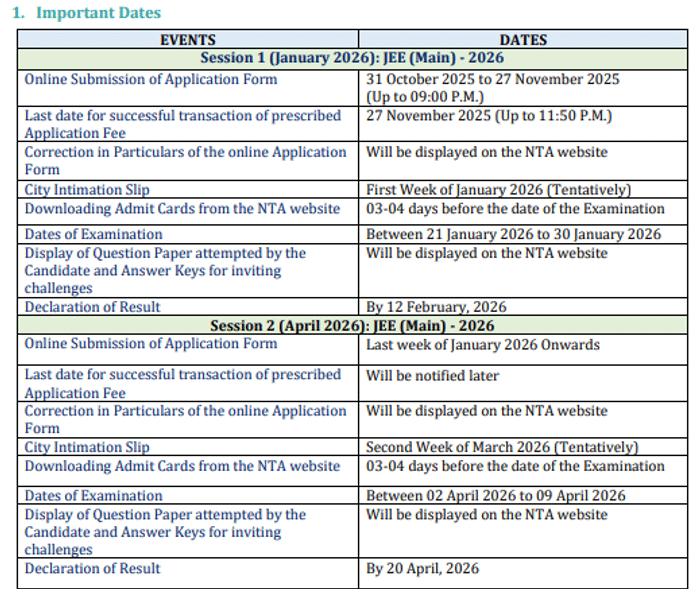
The NTA has released important dates for JEE Main 2026 in the information brochure, which includes dates for city intimation slip, admit card, answer keys and result as well.
JEE Main 2026 Schedule for Session 1 & Session 2
| Event | Session 1 (Jan 2026) | Session 2 (Apr 2026) |
|---|---|---|
| Application Start Date | October 31, 2025 (Over) | Last week of January 2026 |
| Last Date to Apply / Fee Payment | November 27, 2025 (till 9-11:50 PM) (Over) | (Expected) by the end of February / early-March 2026 |
| Form-Correction Window | December 1–2, 2025 | After Session-2 registration — exact dates to be announced |
| City Intimation Slip Release | First week of January 2026 | Around late March / early April 2026 (tentative) |
| Admit Card Release | 3–4 days before exam date | Same — 3–4 days before the respective exam date |
| Exam Dates | January 21–30, 2026 | April 2–9, 2026 (some sources mention April 1–10) |
| Answer Key & Result (Session 1) | Expected early February 2026 | Result for Session 2 — to be declared after exams, likely mid-April 2026 |
Source: jeemain.nta.nic.in
Check:
JEE Main City Intimation Slip
The JEE Main City Intimation Slip is a pre-exam notice that is released by NTA for JEE Main 2026.
What the City Intimation Slip Contains & What It Does Not
| Info on Slip | Details |
|---|---|
| Candidate Information | Application number, name, father’s name, DOB, category, PwD status, medium of question paper |
| Allotted Test City | Name of the city where your exam centre will be located |
| Exam Date | The date on which you are scheduled to appear for the exam (Session & date) |
| What’s Not Included | Exact exam centre name & address, exam time/shift — these will come only on the Admit Card |
How to Check JEE Main City Intimation Slip?
The “JEE Main City Intimation Slip” is released by NTA to inform about the allotted city and the exam date, including the full centre address, along with shift timings, with the admit card.
- Visit the official website: jeemain.nta.nic.in and on the homepage, click on “JEE Main 2026 City Intimation Slip” and log in using your application number and password.
- Then the allotted exam city + exam date will appear, and you can then download and plan accordingly.
Also, Check: JEE Main Admit Card
JEE Main Exam Centres
The JEE Main Exam is conducted in around 323 exam centres in India and international cities, as per the cities selected during the registration process.
You should appear only at the exam centre which is mentioned on the admit card, including full address, reporting time and exam-day instructions.
Ques. Will I get to choose my exam centre for JEE Main 2026? I heard something about Aadhaar-based allocation rather than centre preference?
Ans. No, as per the new rule of JEE Main 2026, the candidates can not select their exam centr;, now the exam centres will be allotted on the basis of the address mentioned on the candidate’s Aadhaar Card.
You should update your Aadhaar address and details well before registration to avoid last-minute glitches, as your city might be automatically assigned based on your Aadhaar address.
Check Latest Guidelines on JEE Mains
Confused with new Aadhaar rules & on-screen calculator? Get the free 7-page “JEE Main 2026 Registration New Rules Explained” PDF + Checklist
Drop Your WhatsApp NumberHow many candidates have registered for JEE Main?
The previous year's analysis of the JEE Main registration data (2025 -2024) reveals some clear trends in the candidates' registration.
- Rising Registration: The JEE Main registration has shown a significant rise from 2023, with over 1.3 million candidates registering for session 1 in 2025, which is the highest in four years.
- Pandemic Effect: In the year 2022, there was lower attendance, i.e, Session 1 – 88.16%, Session 2 – 86.88% due to post-COVID.
- Improved Attendance: From 2023 onwards, the JEE Main attendance has stabilized at 95% in Session 1 across years. Whereas, in every year, Session 2 consistently had lower attendance rates compared to Session 1.
| Year | Session | Registered | Appeared | Attendance Rate |
|---|---|---|---|---|
| 2025 | Session 1 (Jan-2025) | 1,311,544 | 1,258,136 | ~ 95.93 % |
| Session 2 (Apr-2025) | 1,061,840 | 992,350 | ~ 93.50 % (approx) | |
| 2024 | Session 1 (Jan-2024) | 1,221,624 | 1,170,048 | ~ 95.85 % |
| Session 2 (Apr-2024) | 1,179,569 | 1,067,959 | ~ 90.55 % | |
| 2023 | Session 1 (Jan-2023) | 860,064 | 823,967 | ~ 95.75 % |
| Session 2 (Apr-2023) | 931,334 | 883,367 | ~ 94.78 % | |
| 2022 | Session 1 (June 2022) | 872,970 | 769,604 | ~ 88.16 % |
| Session 2 (July 2022) | 622,034 | 540,242 | ~ 86.88 % |
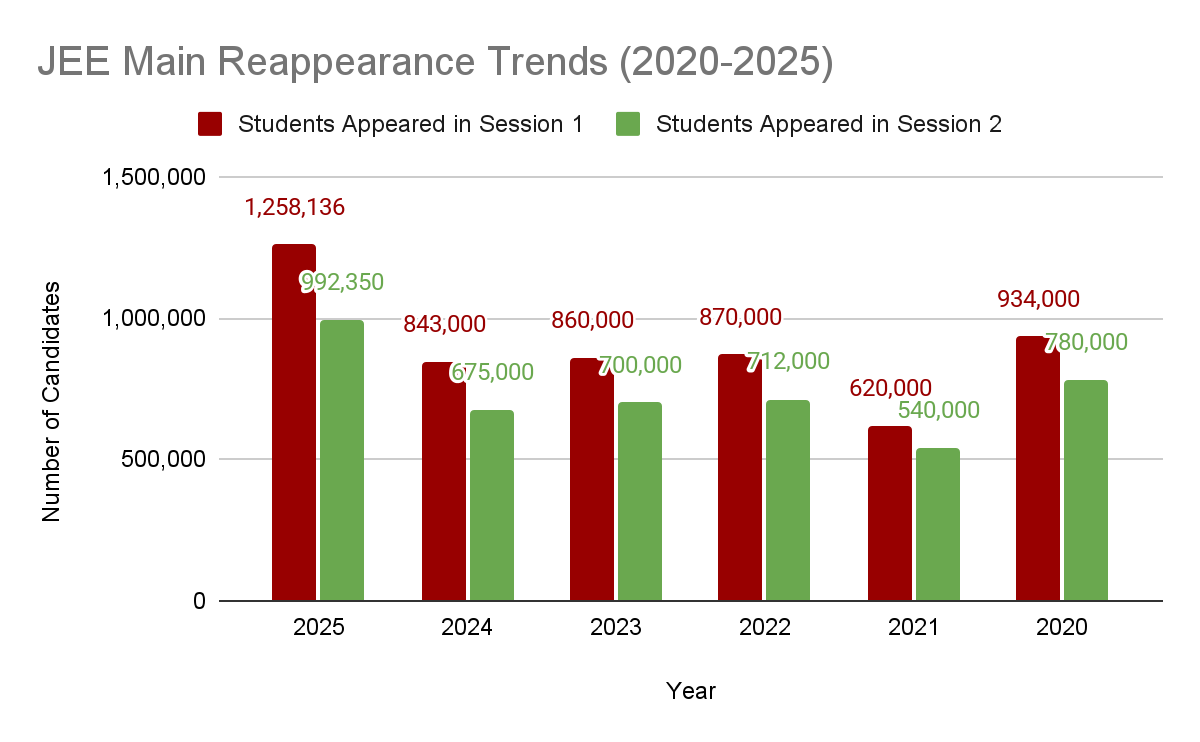
JEE Main Reappearance Trends (2025-2020)
- Between the years 2020 to 2025, an average of 79 - 83 % of candidates reappeared in Session 2, highlighting its significance for improving percentile.
- There was a slight decline in the reappearance trend to 80 % which may be indicative of improved performance or a better level of preparedness in Session 1.
- The rate of reappearance again decreases to 79 %, which could most likely be driven by tougher Math papers as well as shift-wise normalisation-related concerns in Session 1.
| Year | Students Appeared in Session 1 | Students Appeared in Session 2 | % of Students Reappearing |
|---|---|---|---|
| 2025 | 1258136 | 992350 | 79% |
| 2024 | 8,43,000 | 6,75,000 | 80% |
| 2023 | 8,60,000 | 7,00,000 | 81% |
| 2022 | 8,72,000 | 7,12,000 | 82% |
| 2021 | 6,20,000 | 5,40,000 | 87% (highest) |
| 2020 | 9,34,000 | 7,80,000 | 83% |
Also Read
Ques. When to apply for JEE Main 2026?
Ans. The registration for JEE Main 2026 Session 1 is expected to start in the first week of November 2025, you can apply till the last week of November 2026 for JEE Main session 1.
While for the Session 2 the registration will begin in 1st week of Feb 2026 till last week of Feb 2026.
| Registration Start | Registration End | Session |
| First week of November 2025 | Last week of November 2025 | Session 1 (Jan 2026) |
| First week of February 2026 | Last week of February 2026 | Session 2 (April 2026) |
Ques. Can I apply for both sessions in JEE Main 2026?
Ans. Yes, you can apply for both the sessions of JEE Main 2026, the highest of your two scores will be considered. You can also apply for only 1 session.
To apply for both JEE Main sessions you will need to:
- Separate Application Fees: If you wish to apply for both sessions then you will need to register for session 1 and session 2 separately and you need to pay an individual registration fee for each session as well.
- Best of both score counts: If you appear in both sessions, then the best JEE Main score among the two sessions will be considered for ranking or merit list.
- No requirement to do both: It is not mandatory to appear in both sessions, you can also choose either session.
Ques. What if I face registration errors like “Same Credentials Found”?
Ans. If you are facing the registration errors like “Same Credentials Found” during JEE Main 2026 registration the it means that an account has been already registered under same email address or mobile number.
Then you need to
- Login instead of registering again: Rather than attempting to register again as a new user, you should use the existing credentials to log in.
- Recover your Application Number: If you have forgotten your application number or password, you should recover it by providing the required details to retrieve your application number in the "Forgot Application Number" link.
- Contact the JEE Main Helpdesk: If you are still unable to proceed, reach out the JEE Main helpdesk for assistance by providing them your application number, registered mobile number, and details of the issue you're facing.
Ques. What papers (Paper 1 / 2A / 2B) can I select, and can I change them later?
Ans. In JEE Main 2026, there are 3 different papers: Paper 1 (for B.E./B.Tech aspirants), Paper 2A (for B.Arch aspirants), and Paper 2B (for B.Plan aspirants). You can choose one or more out of these papers as per your preference or desired course of study.
Yes, you can modify your paper selections during the application correction window. The JEE Main Correction window provides you with the facility of:
- Adding a paper that you initially did not select.
- You can also remove a paper you no longer wish to appear for.
Ques. Do I need to carry original documents on exam day or registration day?
Ans. Yes, you need to carry the original documents on both the registration day (during the application process) and the exam day (at the exam center) of the JEE Main 2026.
For the Registration Day (Application Process)
As the JEE Main registration is an online process, you dont need to physically present original documents during the registration process, but you must have the following original documents with you:
- Class 10 Marksheet
- Class 12 Marksheet or Certificate
- Valid Photo ID Proof (Aadhaar card, passport, voter ID, or any government-issued ID)
- Scanned Passport-sized Photograph and Signature
- Category Certificate (SC/ST/OBC-NCL/EWS).
- PwD Certificate, If applicable.
At the JEE Main Exam Center
On the day of JEE Main exam you must carry the following original documents with you for entry into the exam centre.
- Printed Admit Card
- Valid Photo ID Proof (Aadhaar card, passport, voter ID, or any government-issued ID)
- Passport-sized Photograph
- PwD Certificate
- Transparent Ball Point Pen
Ques. What if fee payment is deducted from bank, but form shows “failed” or “pending”?
Ans. If the JEE Main application Fees have been deducted from your bank account but your application status shows “Failed” or “Pending”, then follow these steps to resolve the issue:
- Wait for 24 hours: Sometimes, it takes 24 hours to update the payment staus, and monitor the payment status.
- Verify Bank Transfer: Check your bank statement or transaction history to confirm if the payment has been successfully made or not, make sure your transaction ID and amount match the details provided during registration.
- Contact NTA Helpdesk: If nothing has worked, then contact the helpdesk of JEE Main - NTA through: Helpline Number: 011-40759000 or email: jeemain@nta.ac.in. by providing your details like: Transaction ID and reference number, Date and time of payment, Bank statement or payment confirmation screenshot, Your JEE Main application number and personal details.
Session 1 vs Session 2: Which One Is Better for Scoring High?
JEE Main 2026 will be conducted in 2 sessions, Session 1 (January) and Session 2 (April).
Based on 2025 trends, nearly 70% of students who appeared in both sessions improved their percentile in Session 2, thanks to better preparation and strategic adjustments.
Session 1: Early Attempt Advantages
- Session 1 of JEE Main provides real-world exam experience, allowing candidates to understand the NTA’s pattern and adaptive difficulty before Session 2.
- It also provides an early rank advantage, which means that the high-performing candidates can secure the top percentiles early and focus later on JEE Advanced 2026 or board exams.
Session 2: The Improvement Window
- In the JEE Main Session 2, candidates have 2-3 months after their board exams to prepare for the JEE Main and can thus complete full-syllabus revision, mock tests, and targeted practice.
- Session 1 scores act as feedback. Students can identify weak topics and refine their accuracy and time management.
JEE Main 2026 Exam Pattern
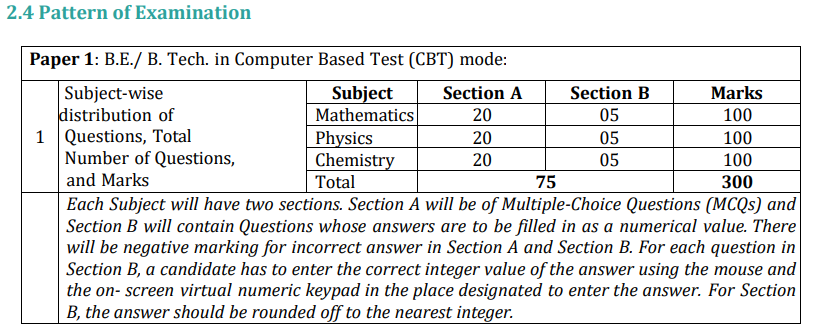
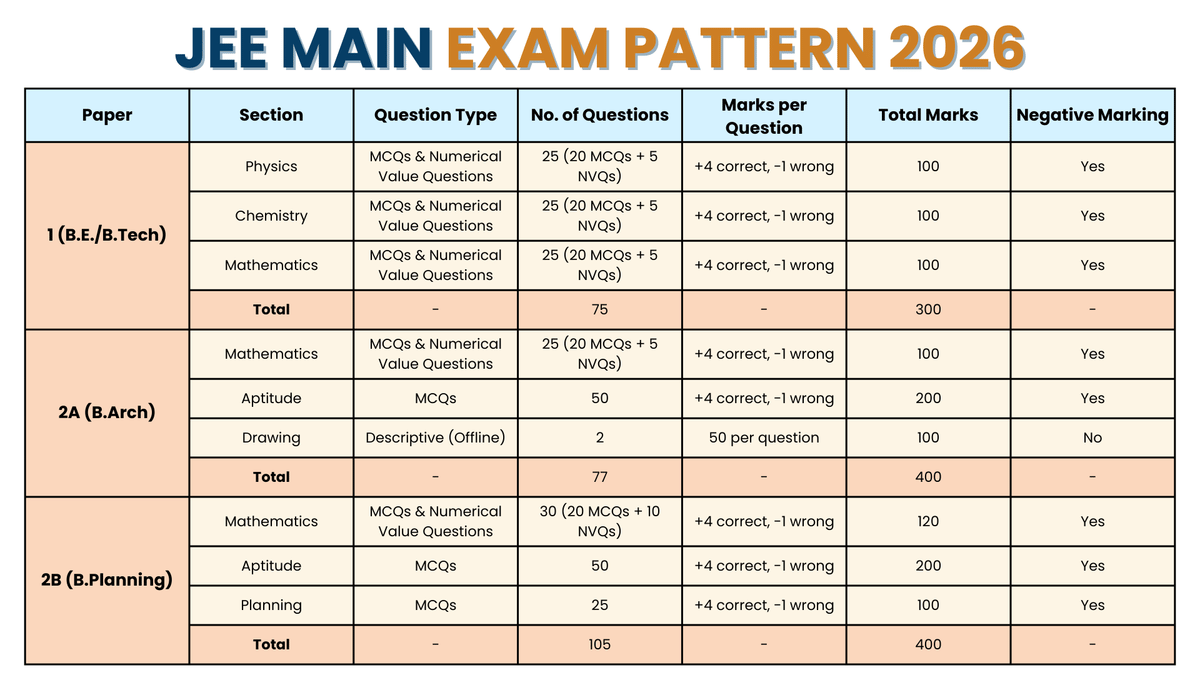
The NTA will release the JEE Main exam pattern 2026 on its official website for all 3 papers: Paper 1 (BE/BTech), Paper 2A (BArch), and Paper 2B (BPlan). As per the previous year’s JEE Main exam pattern, the exam will be conducted in the CBT mode for Paper 1 (B.E./B.Tech) and Paper 2B (B.Planning), whereas Paper 2A will be in hybrid mode (Computer-Based Test with Offline Drawing Test).
Source: JEE Main Official Brochure
JEE Main Exam Pattern Paper 1 (B.E./B.Tech)
| Section | Type | No. of Questions | Marks per Question | Total Marks | Negative Marking |
|---|---|---|---|---|---|
| Physics | MCQs & Numerical Value Questions | 25 (20 MCQs + 5 NVQs) | +4 for correct, -1 for incorrect | 100 | Yes |
| Chemistry | MCQs & Numerical Value Questions | 25 (20 MCQs + 5 NVQs) | +4 for correct, -1 for incorrect | 100 | Yes |
| Mathematics | MCQs & Numerical Value Questions | 25 (20 MCQs + 5 NVQs) | +4 for correct, -1 for incorrect | 100 | Yes |
| Total | 75 | 300 |
JEE Main Exam Pattern Paper 2A (B.Arch)
| Section | Type | No. of Questions | Marks per Question | Total Marks | Negative Marking |
|---|---|---|---|---|---|
| Mathematics | MCQs & Numerical Value Questions | 25 (20 MCQs + 5 NVQs) | +4 for correct, -1 for incorrect | 100 | Yes |
| Aptitude | MCQs | 50 | +4 for correct, -1 for incorrect | 200 | Yes |
| Drawing | Descriptive (Offline) | 2 | 50 per question | 100 | No |
| Total | 77 | 400 |
JEE Main Exam Pattern Paper 2B (B.Planning)
| Section | Type | No. of Questions | Marks per Question | Total Marks | Negative Marking |
|---|---|---|---|---|---|
| Mathematics | MCQs & Numerical Value Questions | 30 (20 MCQs + 10 NVQs) | +4 for correct, -1 for incorrect | 120 | Yes |
| Aptitude | MCQs | 50 | +4 for correct, -1 for incorrect | 200 | Yes |
| Planning | MCQs | 25 | +4 for correct, -1 for incorrect | 100 | Yes |
| Total | 105 | 400 |
JEE Main PYQ Chapter Wise PDF Download
JEE Main PYQ is an important part of preparation. Solving JEE Main PYQs can help candidates to understand the type and level of questions asked in JEE Main examination. Candidates can go through the table below to check the JEE Main PYQs chapter-wise PDF.
| JEE Main 2025 Exam Date | JEE Main 2025 Question Paper | JEE Main 2025 Solution PDF |
| JEE Main 2025 Jan 22 Shift 1 Question Paper | Download PDF | Check Solutions |
| JEE Main 2025 Jan 22 Shift 2 Question Paper | Download PDF | Check Solutions |
| JEE Main 2025 Jan 23 Shift 1 Question Paper | Download PDF | Check Solutions |
| JEE Main 2025 Jan 23 Shift 2 Question Paper | Download PDF | Check Solutions |
| JEE Main 2025 Jan 24 Shift 1 Question Paper | Download PDF | Check Solutions |
| JEE Main 2025 Jan 24 Shift 2 Question Paper | Download PDF | Check Solutions |
| JEE Main 2025 Jan 28 Shift 1 Question Paper | Download PDF | Check Solutions |
| JEE Main 2025 Jan 28 Shift 2 Question Paper | Download PDF | Check Solutions |
| JEE Main 2025 Jan 29 Shift 1 Question Paper | Download PDF | Check Solutions |
| JEE Main 2025 Jan 29 Shift 2 Question Paper | Download PDF | Check Solutions |
| JEE Main 2025 Jan 30 Shift 1 B.Arch Question Paper | Download PDF | Check Solutions |
| JEE Main 2025 April 2 Shift 1 Question Paper | Download PDF | Check Solutions |
| JEE Main 2025 April 2 Shift 2 Question Paper | Download PDF | Check Solutions |
| JEE Main 2025 April 3 Shift 1 Question Paper | Download PDF | Check Solutions |
| JEE Main 2025 April 3 Shift 2 Question Paper | Download PDF | Check Solutions |
| JEE Main 2025 April 4 Shift 1 Question Paper | Download PDF | Check Solutions |
| JEE Main 2025 April 4 Shift 2 Question Paper | Download PDF | Check Solutions |
| JEE Main 2025 April 7 Shift 1 Question Paper | Download PDF | Check Solutions |
| JEE Main 2025 April 7 Shift 2 Question Paper | Download PDF | Check Solutions |
| JEE Main 2025 April 8 Shift 2 Question Paper | Download PDF | Check Solutions |
| JEE Main 2025 April 9 B.Arch Question Paper | Download PDF | Check Solutions |
| JEE Main 2025 April 9 B.Planning Question Paper | Download PDF | Check Solutions |
| JEE Main 2025 April 9 B.Arch & B.Planning Question Paper | Download PDF | Check Solutions |
Ques. Do PYQs help predict what will be asked in the exam?
Ans. Yes, solving PYQs is a highly impactful strategy for JEE Main Preparation, as they will help you identify the trends of the previous years' exams and offer valuable insights into the exam’s structure and recurring topics.
- Identification of Important Topics: The PYQs will help you identify the frequently covered topics, allowing you to prepare accordingly.
- Improved Time Management: Practicing with PYQs will help you manage the time and ability to manage a 3-hour exam duration effectively.
- Enhanced Speed and Accuracy: A regular practice of PYQs helps in developing quicker problem-solving techniques and reduces errors.
Ques. Is it okay to use apps/websites for PYQs instead of books?
Ans. Yes, using apps and websites to solve PYQs for JEE Main can be highly beneficial, especially when integrated effectively into your preparation Strategy.
Most Repeated Questions & High-Weightage Topics (2025–2023)
Analysis of JEE Main papers from 2025 to 2023 shows around 65–70% of questions come from a few key topics across all subjects.
- In Physics, the questions cover chapters like Current Electricity, Modern Physics, Optics, and Thermodynamics carry the highest weightage of 9.9%.
- Chemistry has remained the most scoring section, with Coordination Compounds, p-Block Elements, and Thermodynamics dominating with around 2-3 questions; most questions are NCERT-based.
- In Mathematics, Algebra and Calculus together make up about 70% of the paper, followed by Coordinate Geometry and Functions.
Physics Top Chapters
| Chapter | Approx. Questions* | Approx. Weightage* |
|---|---|---|
| Current Electricity | ~3 questions | ~9.9% |
| Modern Physics | ~2–3 questions | ~6.6%–9% |
| Optics (Ray/Wave) | ~2–3 questions | ~8%–9% |
| Heat & Thermodynamics | ~2–3 questions | ~8%–10% |
| Electrostatics | ~2 questions | ~9.9% |
| Magnetism & Magnetic Effects | ~2 questions | ~6.6% |
| Work, Energy & Power / Rotational Dynamics | ~2 questions | ~6.6% |
| Waves & Oscillations | ~1–2 questions | ~5%–7% |
| Units, Dimensions & Errors | ~1 question | ~3% |
| Gravitation & Properties of Matter | ~1–2 questions | ~5% |
Chemistry Top Chapters
| Chapter | Approx. Questions* | Approx. Weightage* |
|---|---|---|
| Coordination Compounds | ~3 questions | ~9.9% |
| p-Block Elements | ~3 questions | ~9.9% |
| Some Basic Concepts in Chemistry | ~2 questions | ~7.8% |
| Chemical Thermodynamics | ~2 questions | ~6.9% |
| General Organic Chemistry (GOC) | ~2 questions | ~6.6% |
| Redox Reaction & Electrochemistry | ~2 questions | ~6.1% |
| Hydrocarbons / Organic Compounds Containing Oxygen | ~2 questions | ~5.3% |
| d- & f-Block Elements | ~2 questions | ~5.3% |
| Atomic Structure | ~2 questions | ~4.6% |
| Chemical Bonding & Molecular Structure | ~2 questions | ~4.4% |
Mathematics Top Chapters
| Chapter | Approx. Questions* | Approx. Weightage* |
| Algebra (Matrices, Determinants, Quadratic Equations) | ~7–8 questions | ~39.4% |
| Calculus (Integration, Differentiation, Differential Equations) | ~6–7 questions | ~30.7% |
| Coordinate Geometry | ~3–4 questions | ~9.9% |
| Sets, Relations & Functions | ~2 questions | ~7.8% |
| Complex Numbers & Quadratic Equations | ~1 question | ~6.9% |
| Sequence & Series | ~2 questions | ~7.3% |
| Matrices & Determinants | ~2 questions | ~7.1% |
| Statistics & Probability | ~1 question | ~6.3% |
| Binomial Theorem & Applications | ~1 question | ~4.2% |
| 3D Geometry | ~1–2 questions | ~5.3% |
JEE Main Syllabus
The JEE Main syllabus 2026 will be officially announced on the official website of NTA. The JEE Main syllabus 2026 will cover the topics of the NCERT Class 11 and 12 curriculum.
The JEE Main syllabus generally includes topics from Physics, Chemistry, and Mathematics.
- In Physics, there would be topics like Mechanics, Electromagnetism, Thermodynamics, and Optics.
- Chemistry will include topics like Atomic Structure, Chemical Bonding, and Organic Chemistry.
- In Mathematics, the topics would include Algebra, Trigonometry, Calculus, and Probability.
| JEE Main Syllabus 2026 Paper-wise | Download PDF |
|---|---|
| JEE Main Paper 1 (B.E/B.Tech) Syllabus 2026 | Download PDF |
| JEE Main Paper 2A (B.Arch) Syllabus 2026 | Download PDF |
| JEE Main Paper 2B (B.Planning) Syllabus 2026 | Download PDF |
JEE Main 2026 Paper 1 (B.E./B.Tech) Syllabus
| Subject | Detailed Topics |
|---|---|
| Physics |
|
| Chemistry |
|
| Mathematics |
|
JEE Main 2026 Paper 2A (B.Arch) Syllabus
| Section | Detailed Topics |
|---|---|
| Mathematics |
|
| Aptitude Test |
|
| Drawing Test |
|
JEE Main 2026 Paper 2B (B.Planning) Syllabus
| Section | Detailed Topics |
|---|---|
| Mathematics |
|
| Aptitude Test |
|
| Planning-Based Questions |
|
Get FREE College Predictor Report in 2 min
Want to know exactly which NIT & branch you’ll get with your current mock score? Drop your WhatsApp number
Get Report NowJEE Main 2026 Topic-wise Weightage
As per the previous year's analysis of the JEE Main syllabus, it shows a clear distribution across Physics, Chemistry, and Mathematics, highlighting both high-priority and moderately important chapters.
- In Physics, topics like Ray Optics (13.26%), Heat & Thermodynamics (12%), and Current Electricity (12%) are of high weightage and should be prioritized.
- While moderate weightage topics like Electrostatics (10.74%) and Rotational Motion (8%) require focused preparation.
- The topics like Waves & Sound (4%) and Magnetism & EMI (4%) can be revised later, as they have low weight.
- In Chemistry, Chemistry bonding (8–10%), Thermodynamics (6–7%), Coordination Compounds (6–8%), and Hydrocarbons (8–10%) have a high weight and high-scoring areas.
- In Mathematics, Calculus (12–14%) and Coordinate Geometry (10–12%) have the most weight, followed by 3D Geometry & Vectors (6–8%).
- Lower-weightage topics, such as Quadratic Equations, Permutations, and Trigonometry, with around 3-4% weightage, should be revised to complete the syllabus.
Physics Chapter-wise Weightage
| Chapter | Weightage |
|---|---|
| Ray Optics | 13.26% |
| Electrostatics | 10.74% |
| Modern Physics | 5.00% |
| Heat and Thermodynamics | 12.00% |
| Current Electricity | 12.00% |
| Fluid Mechanics & Properties | 8.00% |
| Rotational Motion | 8.00% |
| Waves & Sound | 4.00% |
| Magnetism & EMI | 4.00% |
| Other Topics | 13.00% |
Chemistry Chapter-wise Weightage
Physical Chemistry
| Chapter | Weightage |
|---|---|
| Chemical Bonding | 8–10% |
| Thermodynamics | 6–7% |
| Equilibrium | 4–8% |
| Atomic Structure | 3–4% |
| Chemical Kinetics | 3–4% |
| Solutions & Colligative Properties | 3–4% |
Inorganic Chemistry
| Chapter | Weightage |
|---|---|
| Coordination Compounds | 6–8% |
| p-block Elements | 4–6% |
| d-block & f-block Elements | 4–6% |
| Classification of Elements | 2–3% |
Organic Chemistry
| Chapter | Weightage |
|---|---|
| Hydrocarbons | 8–10% |
| Alcohols, Phenols, Ethers | 4–6% |
| Aldehydes, Ketones | 4–6% |
| Organic Compounds Containing Nitrogen | 4–6% |
| Biomolecules & Polymers | 2–4% |
Mathematics Chapter-wise Weightage
| Chapter | Weightage |
|---|---|
| Coordinate Geometry | 10–12% |
| Calculus (Limits, Derivatives, Integrals) | 12–14% |
| 3D Geometry & Vectors | 6–8% |
| Matrices & Determinants | 5–7% |
| Probability & Statistics | 5–6% |
| Complex Numbers | 4–5% |
| Sequence & Series | 4–5% |
| Quadratic Equations | 3–4% |
| Permutations & Combinations | 3–4% |
| Trigonometry | 3–4% |
Is the JEE syllabus reduced for 2026?
No, the JEE (Joint Entrance Examination) Main syllabus for 2026 is not cut down. The syllabus is the same as last year, which was already cut down by the National Testing Agency (NTA) in 2024. The NTA has made no further announcement for the 2026 exam.
The syllabus of the JEE Main exam aligns with the NCERT topics for Class 11 and 12. The syllabus contains subjects of Physics, Chemistry, and Mathematics. Some of the topics were taken out of the syllabus in 2024, but those are still applicable for 2026.
For 2026, candidates need to concentrate their preparation on the current syllabus that consists of the topics taught in last year's reduced syllabus.
| Subject | Excluded Topics | Percentage of Reduction |
|---|---|---|
| Physics | Magnetism in Matter, Parts of Vector Theory | 5% |
| Mathematics | Selected subtopics in Three-Dimensional Geometry | 3% |
| Chemistry | Polymers' polymerisation methods and Everyday chemicals. | 4% |
Ques. Is the S Block in JEE Main 2026?
Ans. No, the s-block elements are not included in the JEE Main syllabus 2026. The NTA has made some revisions to the JEE Main Syllabus aligning it more closely with the NCERT curriculum by removing some of the sections from Chemistry:
- s-Block Elements
- Hydrogen
- Environmental Chemistry
- Polymers
- Chemistry in Everyday Life
- Surface Chemistry
- States of Matter
- General Principles and Processes of Isolation of Metals
Ques. What is the 80/20 rule for JEE Main?
Ans. The 80/20 rule also known as the Pareto Principle, which a strategic approach to JEE Main preparation that focus on the most impactful topics to maximize your score effectively.
The 80/20 rule suggests that 20% of your efforts like mastering high-weightage topics, can provide 80% of your results.
- High-Impact Topics: Focus on the high weighatge topics that have frequently occurred in the past exams.
- Efficient Parctice: Prioritize practice questions as per the exam pattern
- Strategic Time Management: You should allot a study time to the hight return questions.
JEE Main Difficulty and Shift Level Analysis
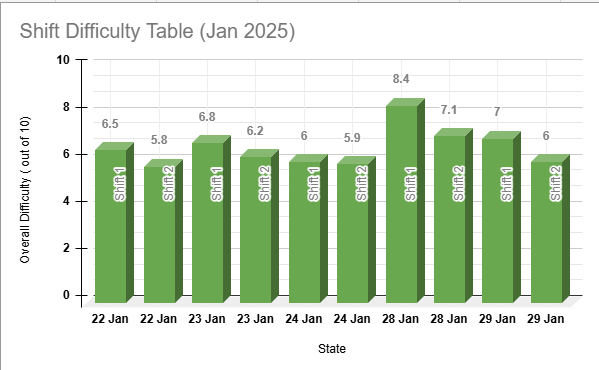
Variation in the level of difficulty across different shifts was observed in the January 2025 session of JEE Main. The ratings ranged between 5.8 to 8.4. Shift 1 held on 28 January was identified as the toughest. But from the table below, it can be seen that Shift 2 on 22 January was the most balanced exam. These differences highlight the significance of proper shift selection and its impact on the performance of candidates, especially considering the normalisation process.
Shift Difficulty Table (Jan 2025)
| Date | Shift | Overall Difficulty (out of 10) |
|---|---|---|
| 22 Jan | Shift 1 | 6.5 |
| 22 Jan | Shift 2 | 5.8 |
| 23 Jan | Shift 1 | 6.8 |
| 23 Jan | Shift 2 | 6.2 |
| 24 Jan | Shift 1 | 6.0 |
| 24 Jan | Shift 2 | 5.9 |
| 28 Jan | Shift 1 | 8.4 (Toughest) |
| 28 Jan | Shift 2 | 7.1 |
| 29 Jan | Shift 1 | 7.0 |
| 29 Jan | Shift 2 | 6.0 |
How Candidates Should Prepare for JEE Main 2026 Based on 2025 Data:
- Targeting Multiple Attempts: As the difficulty level varies across different shifts, candidates must try to appear in January as well as April sessions to improve their chances of getting an easier exam paper.
- Preparation for Extremes: Since the shifts range between the moderate level (5.8) to an extremely tough level (8.4), candidates must strengthen their depth as well as speed, especially for topics like Thermal Physics and Maths.
- Participating in Shift-based Mock Tests: Candidates must take part in full-length mock tests that have been prepared after exams with different difficulty levels. It can boost their mental flexibility while facing actual tough papers
JEE Main 2026 Phase-1 Difficulty Level [Expected]
For the JEE Main 2026 session 1, it is expected that a balanced, slightly difficult paper will be maintained across Physics, Mathematics, and Chemistry. On the basis of the analysis of JEE Main 2024 and 2025, candidates can expect similar patterns of questions, moderate change in shift difficulty, and a proper focus on topics covered in Class 12.
What This Means for JEE Main 2026 Aspirants
While preparing for JEE Main 2026, candidates can expect the following based on the trend analysis:
- The difficulty level of the exam is expected to be moderate to tough, and Math is expected to be the toughest section.
- The syllabus of Class 12 will have the maximum number of questions from sections like Chemistry and Physics.
- Shift-wise variation is probable; therefore, candidates must focus on multiple attempts during January and April sessions.
Subject-Wise Difficulty Level and Key Focus Areas - JEE Main 2026 (Expected)
| Subject | Expected Difficulty Level | Key Focus Areas |
|---|---|---|
| Physics | Moderate | Conceptual clarity, numerical problems from Mechanics, Modern Physics, and Thermodynamics. |
| Chemistry | Easy | Direct NCERT-based Inorganic Chemistry, straightforward Organic, and Physical Chemistry numericals. |
| Mathematics | Tough | Lengthy and time-consuming problems from Algebra, Calculus, and Coordinate Geometry. |
| Overall | Moderate to Difficult | Strong time management and multi-chapter integration questions are expected. |
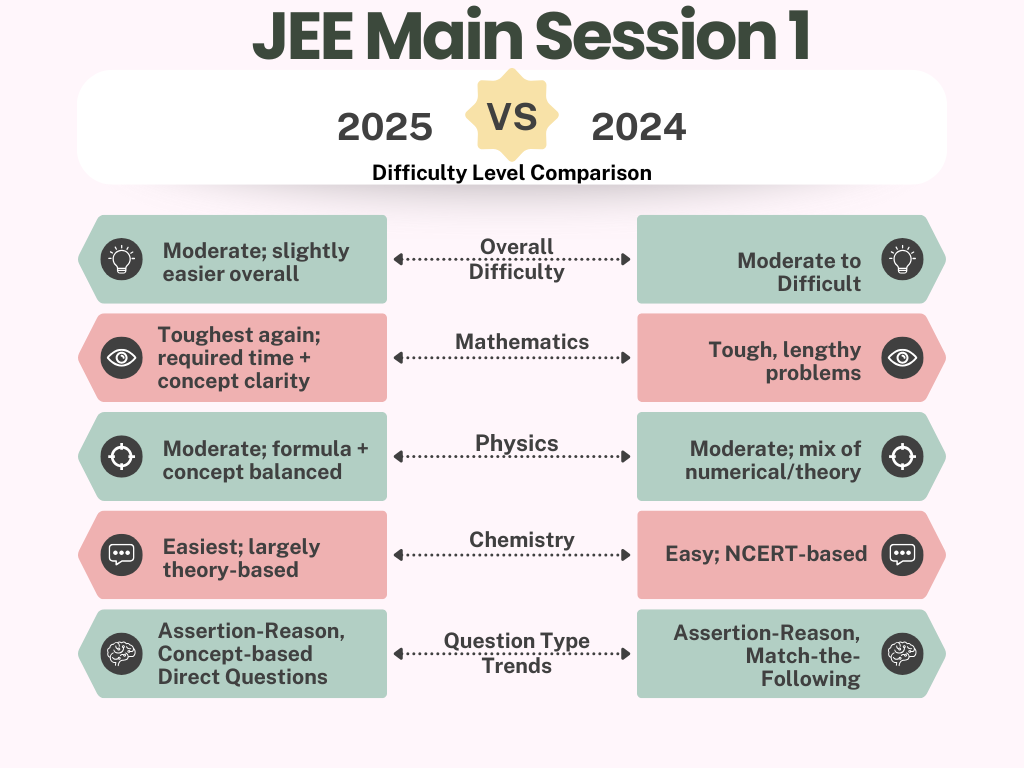
JEE Main Session 1: 2024 vs 2025 - Difficulty Level Comparison
| Criteria | JEE Main 2024 (Session 1) | JEE Main 2025 (Session 1) |
|---|---|---|
| Overall Difficulty | Moderate to Difficult | Moderate; slightly easier overall |
| Most Difficult Shift | Jan 30 – Shift 2 | Jan 28 – Shift 1 (Rated 8.4/10) |
| Mathematics | Tough, lengthy problems | Toughest again; required time + concept clarity |
| Physics | Moderate; mix of numerical/theory | Moderate; formula + concept balanced |
| Chemistry | Easy; NCERT-based | Easiest; largely theory-based |
| Question Type Trends | Assertion-Reason, Match-the-Following | Assertion-Reason, Concept-based Direct Questions |
| Syllabus Focus | Class 11 & 12 balanced | More weight to Class 12 chapters |
| Time Management Need | Needed for lengthy Math | Crucial, especially for Mathematics |
| Student Feedback | Chemistry was scoring; Math was hard | Chemistry was predictable & easiest; Math most challenging |
How to Prepare for JEE Main 2026 Based on Past Trends
- Mastering Concepts from Class 12: Candidates must focus on chapters covered in Class 12, such as Calculus, Probability (in Maths) and Organic & Inorganic Chemistry (in Chemistry).
- Prioritising Time Management: Aspirants must practice full-length mock test papers under time pressure with varying levels of difficulty so that they can accurately solve lengthy Math questions.
- Developing a Robust Strategy for Any Shift: As the difficulty level may vary depending on the chosen shift, candidates must adopt a flexible approach and participate in both sessions to improve their percentile.
JEE Main 2026 Preparation Tips
To score well in JEE Main 2025, candidates need a structured approach, focusing on key concepts, solving practice papers, and effective time management. Some expert tips to prepare are given below:
| Tip | Key Focus | Recommended Hours/Day |
|---|---|---|
| Understand Syllabus & Pattern | Prioritize high-weightage topics for efficiency. | 1-2 hours |
| Time Management | Create and follow a subject-wise schedule. | 5-6 hours |
| Solve Previous Papers | Practice past questions to identify patterns. | 1-2 hours |
| Practice Mock Tests | Simulate exam conditions to boost accuracy. | 2-3 hours (weekly tests) |
| Daily Revision | Reinforce key concepts and improve weak areas. | 1 hour |
Ques. How Many Attempts are There for JEE Main?
Ans. JEE Main is conducted twice every year in January and April sessions. As per the JEE Main rules for the number of attempts, a candidate can appear for JEE Main 6 times. Students can appear for JEE Main 2 times each year in 3 consecutive years.
| Particulars | Details |
| Total Number of Attempts Allowed | 6 |
| Number of Consecutive Years | 3 |
| Number of Attempts Each Year | 2 |
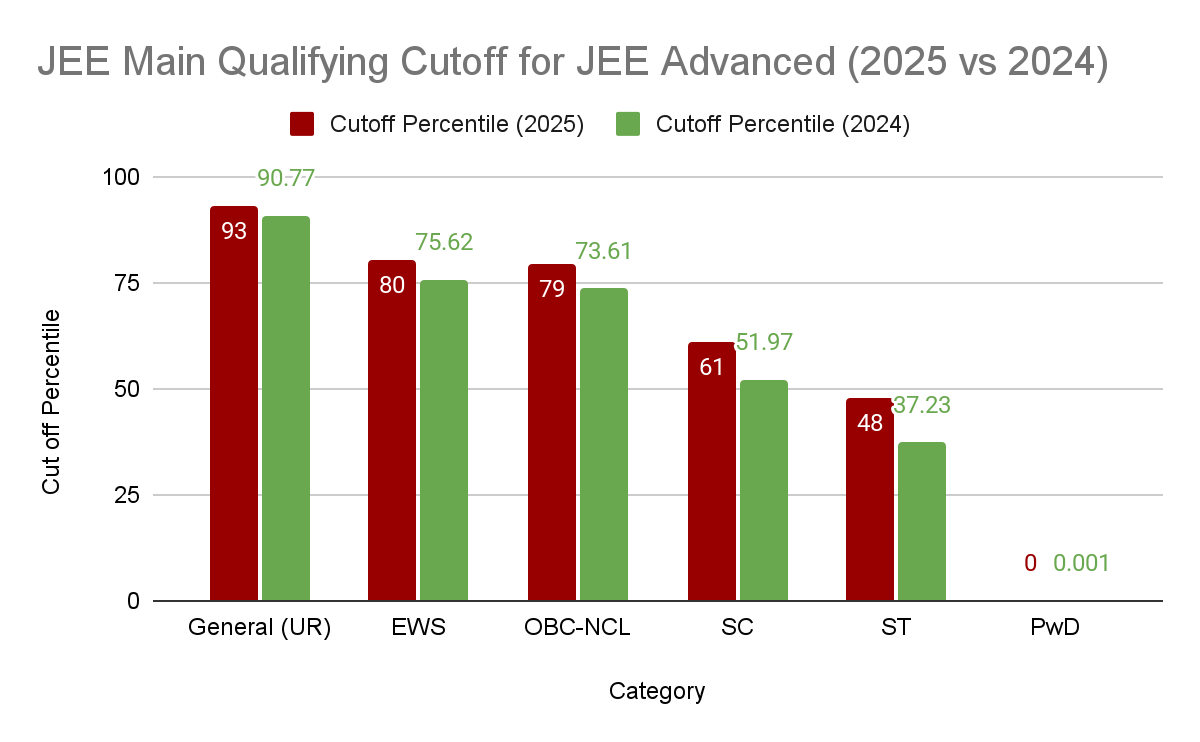
JEE Main Qualifying Cutoff for JEE Advanced (2025 vs 2024)
In JEE Main, the qualifying cutoff refers to the lowest NTA percentile that a candidate needs to score so that they can be eligible for JEE Advanced. The qualifying cutoff varies each year, and it depends on the difficulty level of the exam as well as the process of normalisation. Furthermore, the top 2.5 lakh rank holders across all categories who are able to clear the cutoff become eligible to get registered for JEE Advanced.
- The overall cutoff percentiles have increased in the year 2025 because of increase in competition and a higher average performance of candidates across diverse shifts.
- The cutoff for the General category increased by more than 2.3 percentile points, indicating that eligibility for JEE Advanced has become selective.
- The highest increase was seen in the SC and ST categories, indicating better performance among candidates belonging to these reserved categories or an easier normalisation process.
| Category | Cutoff Percentile (2025) | Cutoff Percentile (2024) |
|---|---|---|
| General (UR) | 93.10 | 90.77 |
| EWS | 80.38 | 75.62 |
| OBC-NCL | 79.43 | 73.61 |
| SC | 61.15 | 51.97 |
| ST | 47.90 | 37.23 |
| PwD | 0.008 | 0.001 |
Also Read
JEE Main Cut off 2025JEE Main 2026 Results
The NTA will release the JEE Main Result session-wise. The Result of the JEE Main session 1(January) is expected to be released in February 2026, and of the JEE Main session 2 (April) is expected in Late April 2026 on its official website.
| Item | Details / Expected Dates |
|---|---|
| Sessions | JEE Main 2026 will be in two sessions: Session-1 (January) and Session-2 (April). |
| Result Dates | Session-1 result is expected to be announced in February 2026. Session-2 result is expected in April 2026. |
| How to access result | Online via the NTA JEE Main official portal (jeemain.nta.nic.in). You’ll need your application number / date of birth / password. The result/scorecard will show subject-wise scores, total/NTA score, All India Rank or percentile as applicable |
| What the Result / Scorecard shows |
|
| Cutoff / Qualifying Percentile | The qualifying percentile (for e.g. being eligible for JEE Advanced, or general qualifying) is expected to be roughly 93-94%ile for General category, based on trend. |
JEE Main Seat Matrix 2026 (Expected)
The JEE Main seat matrix 2026 is expected to provide around 42,000-43,000 seats across the NITs, IIITs, and GFTIs, increased to 60,000 with IITs included.
- NITs lead with 24,500–25,000 seats, followed by 9,800–10,000 in IIITs and 7,800–8,000 in GFTIs, with a steady 3–4% yearly increase driven by new courses and female supernumerary seats.
- The General category candidates will have the largest share of seats, while EWS will have around 7-8% and PwD category will have the horizontal reservation.
- The NITs will have Home State quota of 50%, providing edge to the local candidates, whereas IIITs and GFTIs will follow the AIQ, making competition tougher.
| Institute Type | Expected Total Seats (2026) | General | OBC-NCL | SC | ST | EWS | PwD (across all) | Key Quota/Notes |
|---|---|---|---|---|---|---|---|---|
| NITs (31) | 24,500 – 25,000 | 11,000 | 6,800 | 3,600 | 2,000 | 1,800 | 1,000 | 50% Home State, 50% Other State |
| IIITs (26) | 9,800 – 10,000 | 4,400 | 2,700 | 1,200 | 600 | 800 | 300 | All India Quota |
| GFTIs (38) | 7,800 – 8,000 | 3,600 | 2,000 | 900 | 500 | 700 | 250 | All India Quota |
| IITs* (for JEE Advanced) | 18,200 (for reference) | 8,200 | 4,800 | 2,800 | 1,500 | 1,400 | 500 | Based on JEE Advanced (not JEE Main) |
JEE Main Category-Wise Seat Share (Approx. %)
| Category | NITs | IIITs | GFTIs |
| General (Open) | 45% | 45% | 46% |
| OBC-NCL | 27% | 27% | 25% |
| SC | 15% | 12% | 12% |
| ST | 8% | 6% | 6% |
| EWS | 7% | 8% | 8% |
| PwD (within each) | 5% horizontal | 5% horizontal | 5% horizontal |
JEE Main 2026 Counselling Process
The Joint Seat Allocation Authority (JoSAA) manages the online counselling process at IITs, NITs, IIITs, and other Government Funded Technical Institutions (GFTIs). This means that if a candidate meets the qualifying mark of JEE Main 2025, they may participate in online counselling for admission at NITs, IIITs, or GFTIs.
| Counseling Stage | Details |
|---|---|
| Registration | Starts post-JEE Main results. Register at josaa.nic.in to participate. |
| Choice Filling | Fill and prioritize preferred courses and institutes. |
| Mock Seat Allotment | Two mock rounds help refine choices based on initial trends. |
| Seat Allotment Rounds | Multiple rounds allocate seats based on rank and category. |
| Freeze Option | Accept the allotted seat without further participation in the next rounds. |
| Float Option | Retain the current seat while being considered for higher preferences in the next rounds. |
| Slide Option | Retain the current institute but seek an upgrade to a preferred course within the same institute. |
| Seat Acceptance Fee | Fee: General/OBC ₹35,000; SC/ST/PwD ₹15,000, payable online. |
| Document Verification | Submit and verify required documents for admission confirmation. |
| Dual Reporting | Report twice if switching between seat categories like NITs and IITs. |
| Withdrawal Option | Withdraw admission within deadlines to exit the process |
Also Read
JEE Main 2026 FAQs
Ques. What is the date of JEE Mains 2026?
Ans. The JEE Mains 2026 dates are yet to be released, but based on the last 3 years' pattern, it is expected that session 1 will be on the 2nd or 3rd week of January 2026, while session 2 will be on the 1st or 2nd week of April 2026. The JEE Main 2026 notification is expected in November 2026.
Ques. Who will set the JEE Mains in 2026?
Ans. As in all previous years, the National Testing Agency (NTA) will set up and conduct JEE Mains 2026 in all sessions and centres. NTA is responsible for releasing the official notification, conducting both the sessions, publishing answer keys and declaring results.
Ques. What is the plan for JEE 2026?
Ans. JEE 2026 exam will have MCQs and numerical value questions for all three subjects i.e., Physics, Chemistry and Mathematics. It will be a Computer-Based Test (CBT). Paper 1 (B.E/B.Tech) will have 90 questions. Paper 2A (B.Arch) and Paper 2B (B.Planning) will have their own specific formats with drawing and planning questions. The duration of the exam will be 3 hours.
Ques. How many sessions are there in JEE Mains 2026?
Ans. JEE Main 2026 will be in two sessions:
- Session 1 in January 2026
- Session 2 in April 2026
Ques. Will JEE 2026 be tough?
Ans. The difficulty level of JEE Main varies each year and across shifts. Based on previous years’ analysis:
- Mathematics is usually the toughest and most time-consuming section.
- Physics is moderate with a mix of theory and numerical questions.
- Chemistry is often the easiest, especially for those who focus on the NCERT books.
Ques. Which IIT makes the toughest paper?
Ans. While JEE Main is conducted by NTA, JEE Advanced, which is used for admission into IITs, is prepared by one of the IITs on a rotational basis. As per the records, IIT Bombay and IIT Delhi are known for making tougher JEE Advanced papers, but there is no official pattern indicating that one IIT consistently makes the toughest paper.
Ques. What is the age limit for JEE in 2026?
Ans. There is no upper age limit for JEE Main 2026. However, candidates must have:
- Passed Class 12 in 2024 or 2025, or
- Appearing for Class 12 in 2026.
Ques. Can I crack JEE Mains in 6 months?
Ans. Yes, cracking JEE Main in 6 months is possible with focused preparation. Here are some tips:
- Stick to NCERT textbooks for core concepts.
- Solve previous year question papers and attempt mock tests regularly.
- Dedicate at least 6–8 hours per day to focused study.
- Create a revision schedule for Class 12 chapters and high-weightage topics.
- Use online platforms for doubt-solving and practice tests to simulate real-time conditions.
*The article might have information for the previous academic years, please refer the official website of the exam.
Ask your question
7 Comments


1234567oooooooooooobbbbbbb
Hello ljsdhfg
Answered Questions
- Aim for a score that is higher than 250 and then only after tremendous efforts will you be able to touch the 250 mark.
- Choose a wise mentor who will guide you throughout your exam preparation.
- Continuous revision will do wonders for your preparation. Even if you are confident in a certain topic, keep revising so that the flow is not broken.
- Work on your weaknesses rather than ignoring them. My friend had joined the Filo-app. One-to-one sessions with tutors helped her a lot in making her understand and practice Math concepts.
- Take mock tests regularly, about once or twice a week. This helps you identify the areas you need to work on and prepares you well.
Lastly, you need to stay optimistic as this journey you have embarked on is tough and requires a lot of determination and motivation. Take care of your health, both physical and mental.
You need to have a higher rank if you want a decent NIT and a good branch. Here is an estimated list of cutoffs for a few reputed NITs.
| Institute | Estimated Cutoff (General category) |
| NIT Warangal | 1000 - 7000 |
| NIT Trichy | 500 - 5000 |
| NIT Surathkal | 300-5000 |
| NIT Jaipur | 1200-8000 |
| NIT Allahabad | 500-10000 |
These are approximate opening and closing ranks and the cutoff for these institutes varies each year.
NCERT books can help a lot to prepare for JEE Mains Chemistry. But it is not sufficient.
Inorganic Chemistry is the most scoring part. And for this section, NCERT books are a must. In past years there were questions directly from NCERT. But read your class notes and textbooks as well.
For Physical and Inorganic Chemistry, NCERT isn’t enough. You need to practice a lot, in order to have a good command of these sections. For these sections, go through the NCERT, make notes for important sections and solve practice series.
The easiest way to score above 200 in JEE Main is to score more than 95+ in Chemistry. It is the easiest section and involves less calculation. For, preparation go through the NCERT books thoroughly. Go through the previous years' question papers as well, the mark distribution almost remains the same.
Mathematics is scoring too but it takes longer to finish the section. For mathematics, practice as much as you can. Solve coaching materials, Arihant book series, NCERT, and previous year’s questions.
The physics section is often unpredictable. You can follow NCERT, HC Verma to prepare for Physics.
If you prepare well, Mathematics and Physics section should fetch you more than 110+ marks put together. This is the easiest way to score above 200 in JEE Main.
Here are some of the scoring and important chapters for JEE Main examination.
Physics JEE Main Important Topics:
- NLM-Friction, WEP-CIP
- Ray Optics
- Error & Experiment
- Electrostatic, Currents, Capitals
- Gravitation, Properties of Matter, Fluid Statics & Dynamics, Law of Thermodynamics, Heat Transfer, KTG
- Modern Physics
Chemistry JEE Main Important Topics:
- Atomic Structure and Periodic Table
- Equilibrium
- Thermodynamics, Gas Law, Chemical Bonding
- Electro, Functional Group, Liquid Solution
- Bio Molecule, Polymers, P Block, Surface Chemistry
- Metallurgy, S Block, Coronation Compound, and Hydrogen
Mathematics JEE Main Important Topics:
- Co-ordinate
- Geometry
- Trigonometry
- Matrix and Determinants
- Algebra
- Calculus
- Vector Algebra
To score well in JEE Main, concentrate on the topics you have a good command of rather than the topics you haven’t covered.


